
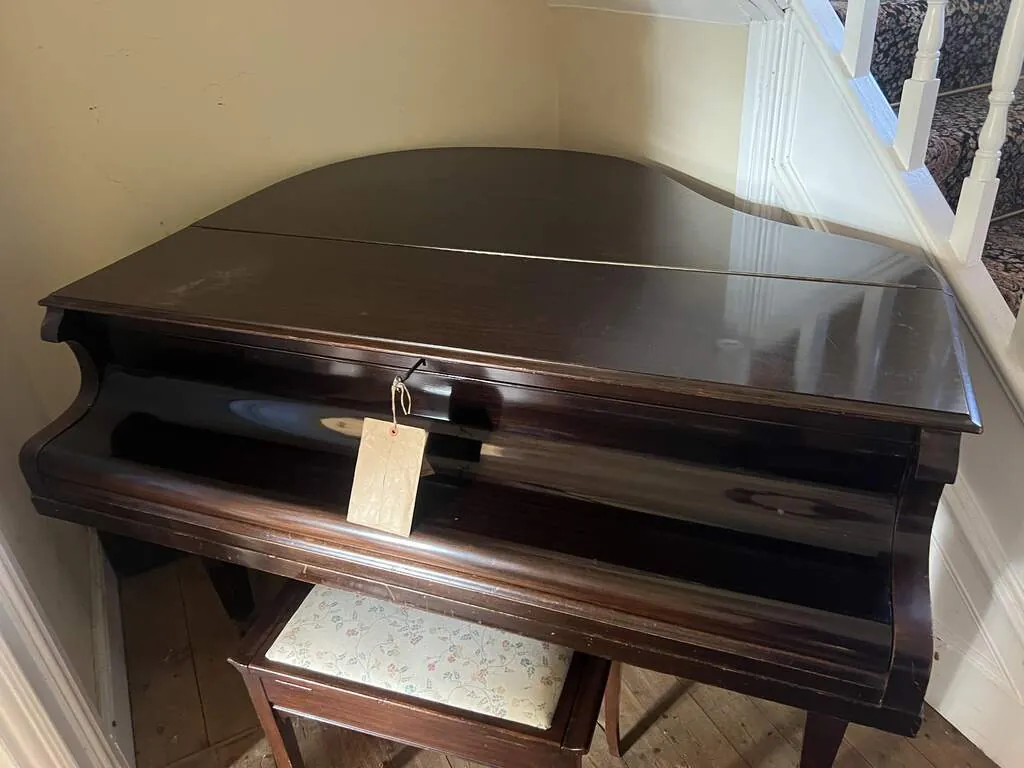
Most of the pianos we collect for recycling have a story behind them, but very few still have their own paperwork. This mahogany baby grand, collected from a family home in north Sheffield, came with its original key, its maker's tag, its warranty envelope and the certificate itself, all kept safe by the man who bought it brand new.
Clearing a family home
We had been asked to collect the piano for recycling. Our customer was clearing the house after losing both parents, which is never an easy job, and the piano stood in a corner by the stairs, waiting to go. Their father had bought it new, and he was very proud of it.
You can tell how much an instrument meant to somebody by what they kept, and he kept everything. The key was still tied with its original string to the Co-operative Wholesale Society's tag. The buff envelope the warranty arrived in was still there, and so was the certificate, folded but in remarkable condition.

Between them, the tag and envelope record the piano as a style HM No 4 baby grand in mahogany, serial number 3491, supplied through the furniture department of the Scunthorpe Co-operative Society.

The certificate guarantees the piano “against any defects of workmanship or material for the term of five years from date”. Our customer joked that the warranty had only just run out. It was a light moment on a hard day, and we were glad of it.
Amyl, the Co-op's own piano
Amyl was the Co-operative Wholesale Society's own piano brand. The CWS made furniture as well as groceries, and its cabinet works at Hay Mills in Birmingham built pianos too, sold through local co-operative societies at moderate prices. For many families, the Co-op furniture department was how a good piano came within reach. Most Amyl pianos you come across are uprights, so a grand is a less common sight.
The small print on the certificate is worth reading. It warns that “extreme heat is injurious, and that extreme cold or dampness causes the metal parts of the instrument to rust, swells the action, softens the glue, and checks the varnish.” Nearly a century later, that is still the advice we give anyone thinking about piano storage.
A final send-off
When a piano leaves a house like this one, it is not just furniture going out of the door, and we try to mark that.
When we arrive, we are usually shown to the piano and walked through the route it needs to take out of the house. Before we move it, we photograph it where it stands using our own disposal software. That photo goes back to our servers, where AI turns that particular piano into a farewell image: the same instrument, at rest in a summer meadow at sunset.

The farewell image sits at the bottom of the certificate email every customer receives. It is AI-generated, and it is not meant to pass for a real photograph. It is there to give the piano a gentler goodbye than the back of a van. Click it, and the email opens the real photograph of their piano, taken on the day. We keep that real photo for 30 days so the customer can save a copy if they would like one. We do not keep the farewell image on our servers.
The email itself is a certificate of piano disposal: a unique certificate number, the date, the waste code the piano is recorded under, and our Environment Agency waste carrier licence number. Householders do not need a waste transfer note by law, but we think it is the responsible thing to do, so you know exactly who took your piano and where it has gone.
What happens to it now
Like every piano we collect, this one went back to our yard to be taken apart by hand. We never dismantle a piano in the customer's home. The timber is recycled, usually into briquettes, and the metal is recycled separately, with the aim of sending under 1% of the instrument to landfill. You can read more about how that works on our piano disposal and recycling page.
If you are clearing a house with a piano in it
Clearing a parent's home is hard enough without a quarter of a tonne of piano to think about. A few things that help:
- Look inside before it goes. Pianos and their stools collect paperwork: receipts, warranties, tuning cards and old sheet music. Lift the lid of the stool and check.
- Save the photo. We photograph every piano where it stands and keep that photo for 30 days. Once the piano has gone, that is the picture people tend to want, so save a copy from the email.
- Ask whether it can be saved. Some pianos are worth rehoming, and we will tell you honestly if yours is one of them.
- Be wary of free collection offers. Disposing of a piano properly costs money. If one ends up fly-tipped, the responsibility can come back to the household it came from, so check any collector is a registered waste carrier. Our guide on how to get rid of a piano explains the options.
- Ask for paperwork. A certificate or waste note is your record of who took the piano and where it went.
Piano disposal in Sheffield and South Yorkshire
We are a family business ourselves, three generations on, so we understand what it means when a family piano leaves home. We collect pianos for recycling right across Sheffield and South Yorkshire, including Barnsley, and handle awkward access as a matter of course.
Call our Sheffield number, 0114 483 0217, or ask us for a quote and tell us a little about the piano and where it stands.