
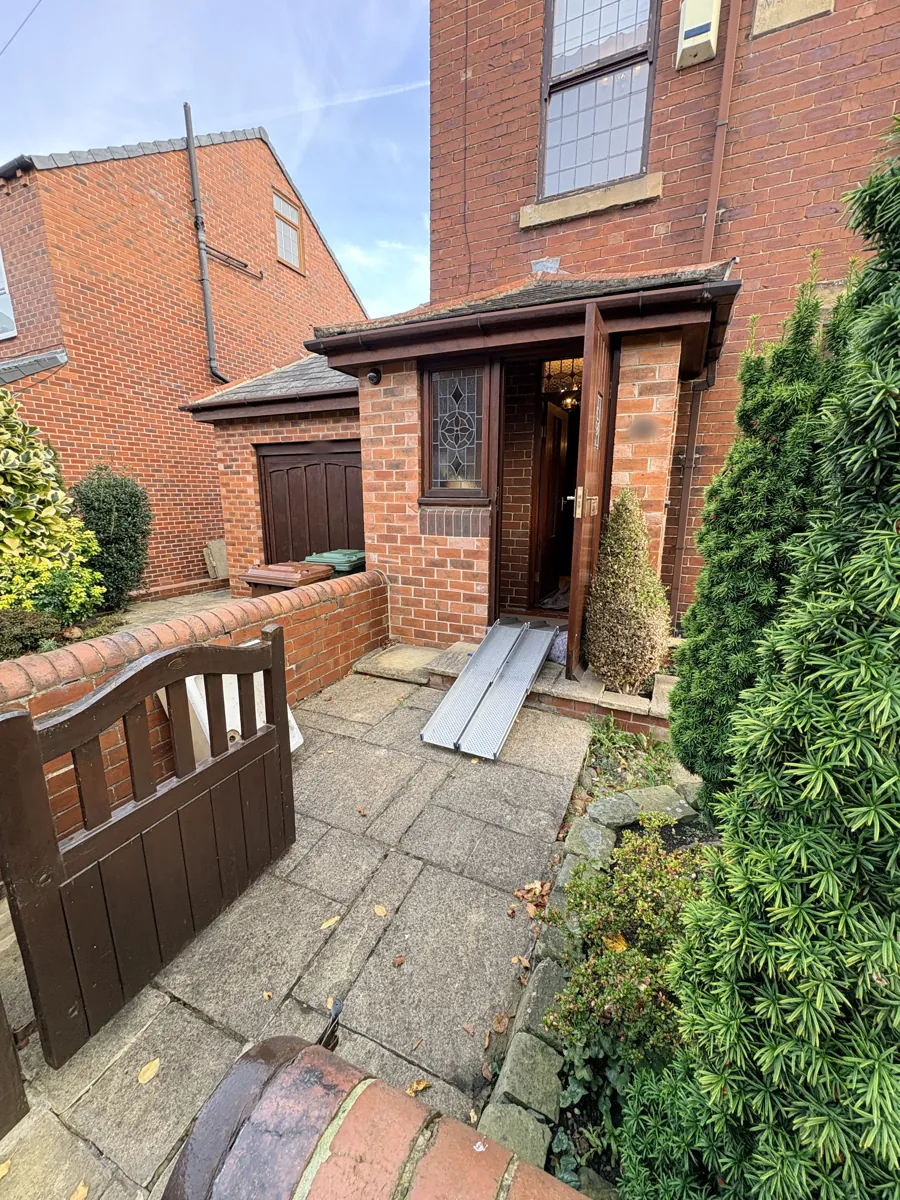
A double porch is one of those features that looks harmless until you picture a piano going through it. This one, on a job in Normanton, meant a step up from the path, a raised threshold at the porch door, and then almost at once another step up into the house itself. Plenty of customers tell us this kind of entrance is the part they worry about most, so here is how it went.
Why double porches need thinking about
A single step at a front door is everyday work. A double porch is awkward because the obstacles come one straight after another, with very little room in between.
- A step up from the path to the outer door.
- A raised threshold on the outer door frame, which the piano has to clear without catching it.
- Another step, sometimes more, almost as soon as the piano lands in the porch. There is no run of flat floor to roll it into the house. It has to be taken up again straight away, in a small space.
- Doorways that do not line up. On some porches the inner door is offset from the outer one, so the piano has to be shifted sideways or angled between the two. Here they were in line, which made it simpler.
So before anything is lifted, we look at the height of each step, the width of both openings, and, just as important, where the piano has to go once it is inside. The route beyond the front door often decides how the piano should travel through the porch.
Ramps over the front step
We laid our telescopic aluminium ramps from the path, up over the step and into the porch. The raised threshold was sheeted first, and the hinge of the ramps sits on that padded area, so the threshold is protected and the ramps have a solid, even point to bear on.
Ramps let the crew roll and guide the piano up the change in level under control, rather than lifting its full weight over the step by hand. They also keep the piano's weight off the step edges and the door frame.

Upended for the turn inside
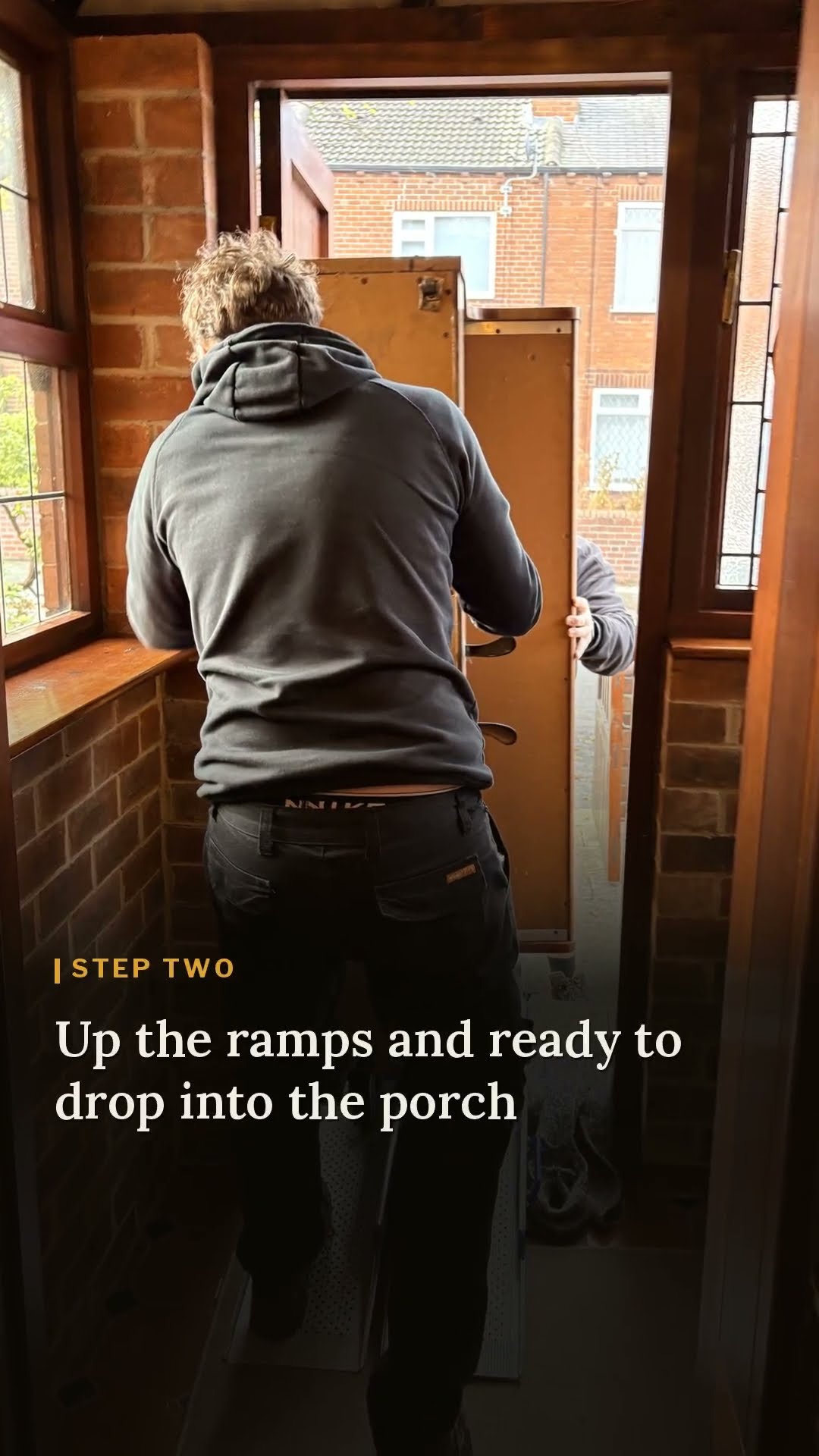
This piano would have gone through the porch on its base. The reason it went in upended, stood on its end, was what came next: once inside the house it had to turn through a doorway at 90 degrees off the hall.
That turn needed the piano on its end. We could have brought it in on its base and upended it in the hall, but turning a piano over in a tight hallway is where walls, skirting and door frames get knocked. It is far safer to upend it outside, where there is room, and bring it through the porch already in the right position for the turn. By the time it reached the inner doorway it was ready to go straight round the corner.
Standing an upright on its end is a normal way to handle it in tight spaces, and done properly it does the instrument no harm.

Into the house
Landing in the porch, the piano had to go straight up the next step into the house, with little room to set up. It was taken slowly, with the frames protected. Inside, the hall floor was sheeted before the piano came through, and the sheets stay down until the piano is in position.

Worried about your own entrance?
Porches, steps up to the door, steps down into a room and narrow halls are all things we plan for, and very few of them stop a move. When you ask us for a quote, tell us about the way in: how many steps, whether there is a porch, and roughly how wide the doors are. A photo of the entrance helps even more. If an entrance genuinely will not take a piano, we will tell you before the day, not on it.
Normanton is one of the Five Towns, and we are regular piano movers in Castleford and the Five Towns as well as across Wakefield and the rest of West Yorkshire. You can read more about our piano removals, or call us on 01484 245977 for a chat about your move.